

The short answer: setting multiple alarms isn't dangerous, but it almost always backfires. Every extra alarm chops the last stretch of your sleep into pieces a few minutes long, drops you back into that groggy just-woke-up state again and again and, over time, teaches your brain that the first alarm doesn't count. For most people the best setup is a single alarm, set for the time you actually need to get up.
In this guide we explain what happens in your body between alarms, what recent studies say, when a backup alarm does make sense, and how to go from five alarms to one in a week without the fear of oversleeping.
The short answer: one alarm beats five
If you set two alarms one day because you have an early flight, that's fine. The problem starts when a chain of alarms becomes your normal way of waking up: 6:00, 6:05, 6:10, 6:15, 6:20… That habit has three costs:
- You sleep in fragments. Between alarms there's only time for light, broken sleep, which is far less restful than the same amount of continuous sleep.
- You get jolted awake several times. Each alarm pulls you out of sleep abruptly and sends you back into sleep inertia, that slow, foggy feeling of the first few minutes.
- The first alarm loses its meaning. If you know four more are coming, the first one stops being a signal to get up and becomes just a heads-up.
Put another way: backup alarms don't help you get up, they help you stay in bed without the risk of being late. And that “insurance” costs you sleep quality.
Why multiple alarms leave you more tired
To see it clearly, compare two mornings for someone who has to be out of bed at 6:20:
| Time | With 5 alarms | With 1 alarm |
|---|---|---|
| 6:00 | First alarm. It jolts you awake and you turn it off. | You keep sleeping without interruption. |
| 6:01–6:04 | You drift back into light sleep. | Continuous sleep. |
| 6:05 | Second alarm. Another abrupt wake-up. | Continuous sleep. |
| 6:10 and 6:15 | Third and fourth alarms. More wake-ups. | Continuous sleep. |
| 6:20 | Fifth alarm. You get up groggy, feeling like you didn't rest. | Your only alarm rings and you get up. |
In both cases you get up at the same time. The difference is that in the first one you've traded 20 minutes of unbroken sleep for five wake-ups and four mini-naps.
You interrupt REM sleep
The last hours of the night are the richest in REM sleep, the stage linked to dreaming and associated with memory and emotional processing. A chain of alarms lands right on top of that stretch and breaks it up.
You multiply sleep inertia
Sleep inertia is the grogginess you feel right after waking: you think more slowly, your coordination is off and you want to go back to bed. With one alarm you go through it once. With five, you restart it five times, and it's exactly in that state that you decide to turn the alarm off and keep sleeping.

Want to stop hitting snooze starting tomorrow?
LevoUp won't turn off until you complete a mission. Try it free for 3 days.
What the studies say
Setting multiple alarms and hitting snooze are two versions of the same habit, and recent research usually looks at them together:
- Stockholm University (2023). In a survey of 1,732 people published in the Journal of Sleep Research, 69% said they hit snooze or set multiple alarms at least sometimes. In a second experiment with 31 habitual snoozers, half an hour of snoozing didn't worsen performance or mood that morning, but sleep during those 30 minutes was less efficient, with more awakenings.
- Mass General Brigham (2025). An analysis published in Scientific Reports of about 3 million nights from Sleep Cycle app users found the alarm was snoozed on roughly 56% of nights. People who snoozed almost daily had more irregular sleep schedules. The researchers' advice: set your alarm for the latest time you can get up and get out of bed with the first one. The study was supported by Sleep Cycle.
Neither study shows that multiple alarms are harmful to your health. What they do show is that it's a very common habit, that it goes hand in hand with short or irregular sleep, and that the sleep between alarms is lower quality. For more detail, see is hitting snooze bad?
The “first one doesn't count” effect
There's a less visible cost: what you learn. If every morning you turn off the first alarm with no consequences, your brain learns that the sound doesn't mean “get up”, it means “20 minutes left”. Over time it's easy to end up needing more alarms, louder ones or closer together to get the same result.
It works the other way too: when you only have one alarm and you know there won't be another, you take it seriously. Many people find that after a few days on a single alarm they wake up more alert, or even a few minutes before it goes off, especially if they keep a regular schedule.
And if you struggle to hear your alarm, or turn it off without realizing, adding more alarms won't fix it. In our guide on sleeping through your alarm we go over the causes and what to do.
When a backup alarm does make sense
A backup alarm is reasonable on days when oversleeping would have serious consequences: an early flight, an exam, a job interview or a shift you can't be late for. In those cases, follow these rules:
- Only one backup. Not five: one.
- Spaced out. Set it 10–15 minutes after the main one, not every 5 minutes. It's insurance in case something fails, not a disguised snooze.
- On another device, if you can. A classic alarm clock or someone else's phone protects you if yours dies or is on silent.
- Only that day. The next day, go back to one alarm.
If your goal is for your main alarm to never fail, an alarm you can't turn off half asleep works better than stacking alarms. We explain it in an alarm that won't turn off until you get up.
How to go from 5 alarms to 1 in 7 days
Deleting every alarm at once is scary. This plan does it gradually:
| Day | What to do |
|---|---|
| Night 1 | Notice what time you actually get up with your alarm chain (for example, 6:20). That's your real wake-up time. |
| Days 1–2 | Delete the alarms in between and keep only two: your real time (6:20) and a backup 10 minutes later. |
| Days 3–4 | Keep the backup, but move it away from the bed: phone or alarm clock on the other side of the room. |
| Days 5–7 | Delete the backup. One alarm, at your real time, at the same time every day. |
For this to work, the night matters as much as the morning. If you're short on sleep, no number of alarms will get you up rested. Work out when to go to bed so your alarm rings at the end of a sleep cycle:
What time should you go to bed?Find out when to go to bed or wake up based on your 90-minute sleep cycles. Open calculatorAnd if you're afraid of falling back asleep with just one alarm, remove the option to turn it off without thinking. In LevoUp the alarm has no snooze button: it only turns off when you complete a mission, like solving a math problem, typing an affirmation, taking a photo of the sky, touching grass or making your bed. By the time you finish, you're awake.
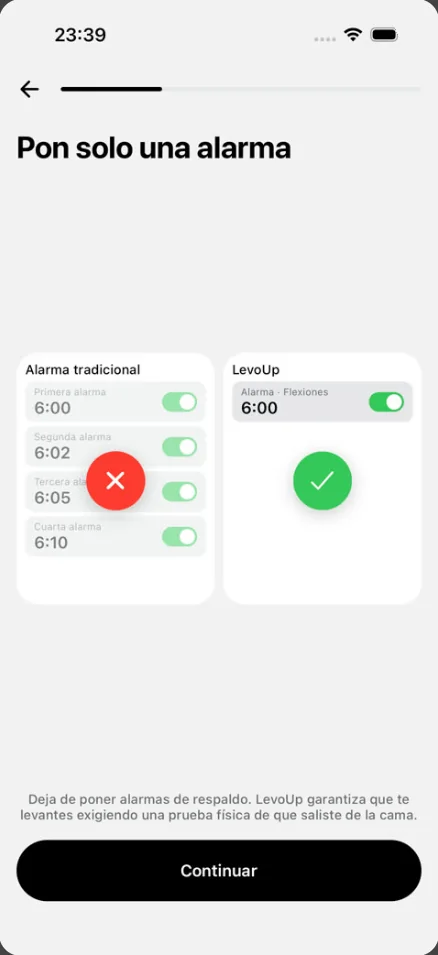
For more tips on breaking the habit, read our guide on how to stop hitting snooze.
What if I don't hear a single alarm?
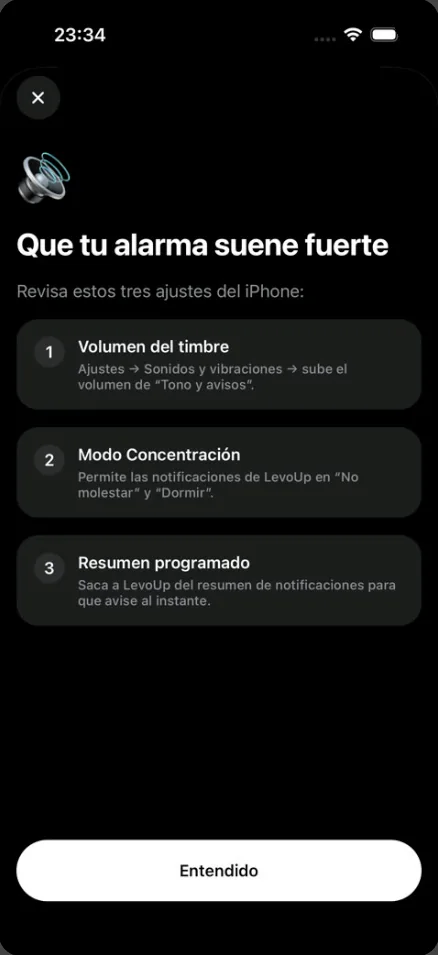
It's the most common fear when giving up backup alarms. Before going back to a chain of five, make sure your one alarm actually rings:
- Ringer volume. On iPhone, alarms use the Ringtone and Alerts volume (Settings → Sounds & Haptics), not the media volume.
- Focus modes. If you use Do Not Disturb or Sleep, check that your alarm app is allowed to notify you.
- Scheduled Summary. Take your alarm app out of the notification summary so it alerts you instantly.
- A sound you don't know by heart. Changing the tone now and then helps keep your brain from tuning it out.
- Test the alarm one afternoon, with the phone locked, before trusting it in the morning.
If you're torn between the iPhone alarm and an app, we compare both in iPhone alarm vs. alarm app.
When to see a doctor
If you sleep 7 to 9 hours on a regular schedule and still can't wake up without several alarms, feel very sleepy during the day, snore loudly or someone notices you stop breathing in your sleep, there may be a sleep disorder behind it. In that case, rather than changing alarms, it's worth talking to a doctor.
For most people, though, the alarm chain is just a habit. And it changes with one well-set alarm and a week of practice.
Frequently asked questions
Is it bad to set multiple alarms to wake up?
It isn't dangerous, but it usually backfires: every extra alarm fragments your last stretch of sleep, sends you back into sleep inertia and teaches your brain that the first alarm doesn't count. One alarm at your real wake-up time is better.
How many alarms should I set?
One. Only on critical days, like a flight or an exam, add a backup 10–15 minutes later and, if you can, on another device.
Why do I wake up more tired with multiple alarms?
Because you trade minutes of continuous sleep for several abrupt wake-ups and mini-naps. That broken sleep is less restful, and each alarm restarts the grogginess of the first few minutes.
What does science say about setting multiple alarms?
A Stockholm University study (Journal of Sleep Research, 2023) found 69% of respondents snooze or set multiple alarms at least sometimes, and that sleep between alarms is less efficient. Mass General Brigham researchers (Scientific Reports, 2025) recommend getting up with the first alarm.
What if I'm afraid I won't hear just one alarm?
Check your Ringtone and Alerts volume, Focus modes and Scheduled Summary, test the alarm before bed and use an alarm you can't turn off without getting up, like a mission alarm.
How do I stop needing so many alarms?
Set your alarm for the time you actually get up, cut alarms down gradually over a week, go to bed on time and keep a regular schedule. A mission alarm like LevoUp keeps you from turning it off half asleep.