

The alarm goes off, you silence it without really opening your eyes and promise yourself “just 5 more minutes.” Twenty minutes later you wake up again, rushed and more tired than before. If this happens every day, you're not alone: hitting snooze is one of the most common morning habits.
The good news is that it doesn't come down to willpower. In this guide we explain why you hit snooze and give you 9 concrete tips, plus a 7-day plan, to stop for good.
Why you hit snooze (and it's not laziness)
When the alarm goes off, your brain hasn't finished waking up. For the first few minutes — sometimes up to half an hour — you experience what researchers call sleep inertia: a groggy state in which you think more slowly and struggle to make decisions.
The part of the brain in charge of self-control and planning, the prefrontal cortex, is one of the slowest to “switch on.” So at 6 a.m., the decision to get up is made by a half-asleep brain that sees only one thing: the bed is warm and the snooze button is one tap away.
Hitting snooze isn't a discipline problem — it's a design problem. You're asking your brain to make a hard decision at the exact moment it's worst at deciding.
Understanding this changes the strategy. Instead of trying to “have more willpower,” the key is to take the decision off your plate before the alarm even rings.
Is hitting snooze bad for you?
The short answer: it depends on how you do it, but it almost never helps you rest more.
The minutes you sleep after hitting snooze tend to be light, fragmented sleep, which doesn't provide the rest of deep sleep. And if the alarm goes off again just as you're slipping into a deeper stage, you can wake up even groggier.
There are nuances: a Stockholm University study published in 2023 in the Journal of Sleep Research found that, in habitual snoozers, around 30 minutes of snoozing didn't impair performance after waking. Still, the real cost usually lies elsewhere: you start the day late, in a rush, feeling like you've already let yourself down before getting out of bed.
If you want calmer, more predictable mornings, the most effective move is to set your alarm for the time you'll actually get up — and get up on the first ring.

Want to stop hitting snooze starting tomorrow?
LevoUp won't turn off until you complete a mission. Try it free for 3 days.
9 tips to stop hitting snooze
1. Set your alarm for your real wake-up time, not the “optimistic” one
If you always snooze three times, you're really getting up 20 or 30 minutes after your first alarm. Set it for that time instead: you'll sleep that stretch uninterrupted, which is far more restful than sleeping in pieces.
2. Move your phone away from the bed
If turning off the alarm means getting up, you're halfway there. Leave your phone across the room, or at least out of arm's reach. Bonus: you won't scroll in bed before sleep.
3. Get enough sleep (at the right time)
Often you hit snooze simply because you didn't sleep enough. Most adults need 7 to 9 hours. To wake up at the end of a sleep cycle, when getting up is easier, work out your bedtime:
What time should you go to bed?Find out when to go to bed or wake up based on your 90-minute sleep cycles. Open calculator4. Keep the same schedule every day
Getting up at the same time Monday through Sunday helps your internal clock anticipate the alarm: over time you'll start waking up more alert, sometimes even a little before it rings. If you need extra rest on weekends, go to bed earlier rather than sleeping in much later.
5. Use a single alarm
Setting five backup alarms teaches your brain that the first one doesn't count. With just one alarm, the message is clear: when it rings, it means it.
6. Have a reason to get up
It's easier to get out of bed when you know what for: a workout, your side project, a calm breakfast. Write it down the night before and keep it in sight. In LevoUp you can save it as “My reason,” and we'll remind you when you need it most.
7. Light and movement in the first few minutes
Open the curtains or switch on the light as soon as you're up, and move your body: a few squats, a stretch, a walk to the kitchen. Light and physical activity are two of the fastest ways to shake off sleep inertia.
8. Remove the decision: use a mission alarm
This is the tip that ties all the others together. A mission alarm can't be turned off with a tap: you have to complete a task, like solving a math problem or snapping a photo of the sky. By the time you're done, you're awake and out of bed.
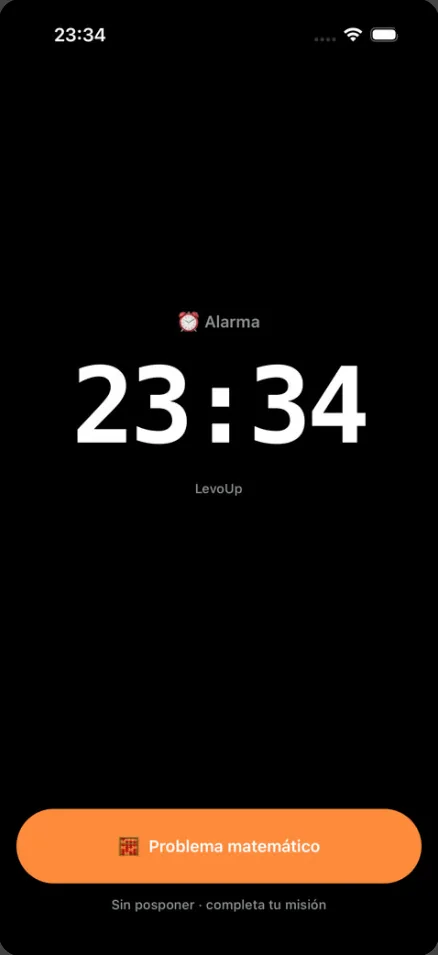
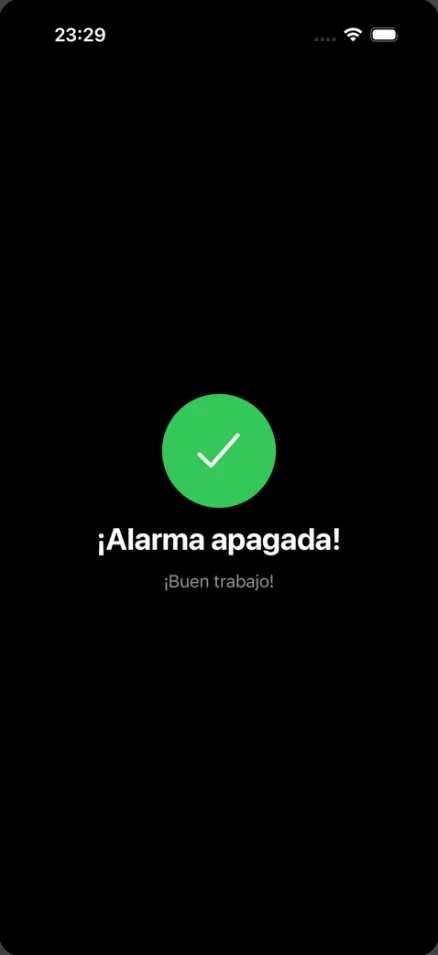
In LevoUp you can choose to solve a math problem, type an affirmation, take a photo of the sky, touch grass or make your bed. If you try to ignore it, it rings again and again.
9. Count your mornings
What gets measured gets better. Tracking the days you get up on the first alarm turns the habit into a small game: the longer the streak, the less you want to break it. LevoUp does this automatically with streaks and badges, and the rest days you choose don't break your streak.
A 7-day plan to stop hitting snooze
Don't try to change everything at once. This plan goes step by step:
| Day | What to do |
|---|---|
| 1 | Write down how many times you snooze and when you actually get up. |
| 2 | Set a single alarm for your real wake-up time. |
| 3 | Leave your phone away from the bed. |
| 4 | Work out your bedtime and go to bed on time. |
| 5 | Write down your reason to get up and keep it in sight. |
| 6 | Light and movement in the first 5 minutes. |
| 7 | Turn on a mission alarm and start your streak. |
By the end of the week, you should be getting up with the first alarm most mornings. If you miss a day, no big deal: pick it up again the next morning.
If you still can't get up
If you sleep 7 to 9 hours on a regular schedule and still find it extremely hard to wake up, or feel very sleepy during the day, something else may be going on: loud snoring, pauses in breathing while you sleep or sleep that never feels restful can be signs of a sleep disorder. In that case, it's worth talking to a doctor.
For most people, though, the problem isn't medical — it's the snooze button. And that one has a fix.
Frequently asked questions
Why do I always hit snooze?
Because right after waking you're in sleep inertia: the part of your brain that controls decisions isn't fully active yet. Deciding to get up at that moment is hard, so snooze wins. The fix is to take that decision away, for example by keeping your phone away from the bed or using a mission alarm.
Is snoozing for 5 minutes bad?
It's not dangerous, but it doesn't help you rest more either: those minutes tend to be light, fragmented sleep. It's more effective to set your alarm for the time you'll really get up.
How many alarms should I set to wake up?
One. Multiple backup alarms teach your brain that the first one doesn't count and break up your last stretch of sleep.
What alarm won't turn off until you get up?
Mission alarms like LevoUp only turn off when you complete a task: solve a math problem, type an affirmation, take a photo of the sky, touch grass or make your bed.
How long does it take to break the habit?
It varies, but with your alarm set to your real wake-up time, your phone out of reach and a fixed schedule, many people notice a change within the first week. Keeping it up for a few weeks makes it automatic.