
Quick answer: if you want to wake up at 6:00 am, the best bedtime is 10:15 pm. That gives you about 7.5 hours of sleep, which is 5 full sleep cycles, plus around 15 minutes to fall asleep. If you need more rest, the other recommended bedtime is 8:45 pm (6 cycles, 9 hours).
Below you'll find the full bedtime chart, how the math works, what to do if you go to bed later and how to make sure your 6 am alarm doesn't turn into three rounds of “five more minutes”.
Chart: what time to go to bed to wake up at 6 am
Sleep runs in cycles of roughly 90 minutes. Waking up at the end of a cycle, when sleep is lighter, tends to be easier than waking up in the middle of deep sleep. This chart counts full cycles back from 6:00 am and adds 15 minutes to fall asleep:
| Bedtime | Cycles | Hours of sleep | Recommended? |
|---|---|---|---|
| 8:45 pm | 6 | 9 h | Yes, if you struggle on less or you're a teenager |
| 10:15 pm | 5 | 7.5 h | Yes, the most balanced option for most adults |
| 11:45 pm | 4 | 6 h | Only once in a while: it's under 7 hours |
| 1:15 am | 3 | 4.5 h | No: it's a short night, emergencies only |
If you'd rather think in round hours than cycles, to get 7 hours of sleep you'd need to be in bed by 10:45 pm, and for 8 hours, by 9:45 pm (both including the 15 minutes to fall asleep).
Waking up at a different time? Use the calculator: pick your wake-up time and it shows every option instantly.
What time should you go to bed?Find out when to go to bed or wake up based on your 90-minute sleep cycles. Open calculatorHow your bedtime is calculated
There are only three pieces to the math:
- Your wake-up time: in this case, 6:00 am.
- Sleep cycles of about 90 minutes: during the night you move through light sleep, deep sleep and REM several times. Each round lasts about an hour and a half on average, but in practice it ranges from roughly 80 to 120 minutes depending on the person and the time of night.
- How long it takes you to fall asleep: we use 15 minutes as a reference. If you're out in 5 minutes or it takes you half an hour, adjust.
Example with 5 cycles: 5 × 90 minutes = 450 minutes, or 7 hours 30 minutes. Counting back from 6:00 am gets you to 10:30 pm. Subtract the 15 minutes to fall asleep and you land on 10:15 pm.
Keep in mind: 90-minute cycles are a useful approximation, not an exact rule. Use it as a starting point and adjust in 15-minute steps based on how you feel in the morning.

Want to stop hitting snooze starting tomorrow?
LevoUp won't turn off until you complete a mission. Try it free for 3 days.
How much sleep do you actually need?
Counting cycles doesn't help much if the total is too short. These are the reference recommendations:
- Adults: at least 7 hours a night, according to the consensus statement from the American Academy of Sleep Medicine and the Sleep Research Society published in 2015.
- Teenagers (13–18): 8 to 10 hours, according to the American Academy of Sleep Medicine consensus from 2016.
That's why, for a 6 am wake-up, the two bedtimes that make the most sense are 10:15 pm and 8:45 pm. The 11:45 pm option leaves you with 6 hours: it can get you through one particular night, but if it becomes your routine you'll build up sleep debt — and with it heavier mornings and a stronger urge to hit snooze.
A practical clue: if you wake up before your alarm with energy after 7.5 hours, you're on track. If you rely on the alarm for everything, struggle to get out of bed and sleep in for hours on weekends, you're probably short on sleep during the week.
Bedtimes for waking up at 5:30, 6:30 or 7 am
Plenty of people search for 6 am but actually get up a little earlier or later. Here's the same math for other common wake-up times (with 15 minutes to fall asleep):
| I want to wake up at… | 5 cycles (7.5 h) | 6 cycles (9 h) |
|---|---|---|
| 5:00 am | 9:15 pm | 7:45 pm |
| 5:30 am | 9:45 pm | 8:15 pm |
| 6:00 am | 10:15 pm | 8:45 pm |
| 6:30 am | 10:45 pm | 9:15 pm |
| 7:00 am | 11:15 pm | 9:45 pm |
If you currently get up at 7:30 am and want to switch to 6:00 am, don't do it overnight. Move your alarm and your bedtime 15 minutes earlier every few days. We walk through it step by step in our guide on how to wake up early.
What to do if you can't fall asleep by 10:15 pm
Knowing the time is easy; sticking to it is harder. These habits help sleep show up on schedule:
1. Fix your wake-up time first
Getting up at 6 am every day, weekends included or close to it, does more than anything else to set your internal clock. Over time, you'll start getting sleepy at a similar time every night on your own.
2. Get natural light in the morning
Light soon after waking helps shift your internal clock earlier, which makes it easier to feel sleepy earlier at night.
3. Plan your last hour of the day
Dimmer lights, fewer screens and nothing that winds you up right before bed. If you're still answering messages at 10:15 pm, it's hard to be asleep by 10:30.
4. Watch caffeine and late dinners
Caffeine can keep working for many hours after you have it. If you have trouble sleeping, skip it in the afternoon and leave some time between dinner and bed.
5. Don't obsess over the exact minute
If you get into bed at 10:40 one night, that's fine. Seven hours of sleep “mid-cycle” beats staying up until 1:15 am just to make the numbers work.
How to actually get up when your 6 am alarm goes off
The other half of the problem is the morning. At 6 am, half asleep, it's very easy to turn off the alarm or hit snooze “just for a minute”. And every time you fall back asleep and wake up again, you restart sleep inertia, that groggy feeling of the first few minutes.
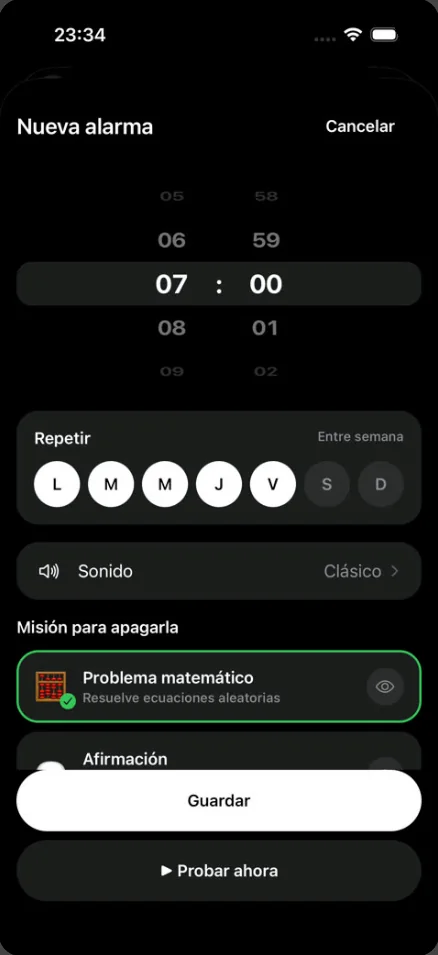
With LevoUp you can set your 6 am alarm for Monday to Friday and choose the mission you'll have to complete to turn it off. There's no snooze button: it keeps ringing until you finish. The available missions are solving a math problem, writing an affirmation, taking a photo of the sky, touching grass or making your bed (push-ups, squats and find an object are coming soon).
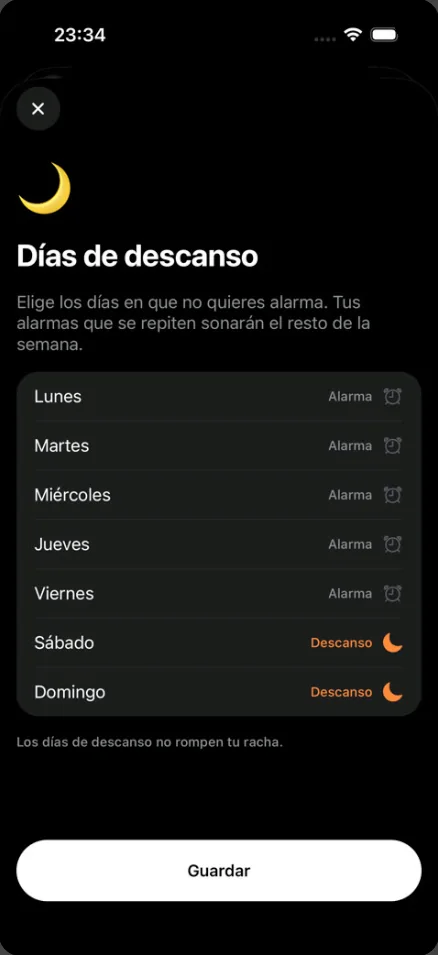
If you want to sleep a bit longer on weekends, you can mark rest days, which don't break your streak. Just try to keep the gap from your weekday wake-up time small so you don't throw your clock off every Monday.
If getting out of bed is especially hard for you, also read how to stop hitting snooze and whether hitting snooze is bad for you.
A sample routine for a 6 am wake-up
Here's what a normal day with a 10:15 pm bedtime could look like:
- 9:30 pm – Dim the lights and leave your phone charging out of reach of the bed.
- 9:45 pm – Brush your teeth and lay out tomorrow's clothes.
- 10:15 pm – Into bed. Read a few pages of a paper book if it helps you relax.
- 6:00 am – The alarm goes off. You get up and complete your mission, for example the photo of the sky, which also gives you natural light.
- 6:10 am – Water, shower and breakfast. The worst of the grogginess usually fades within the first half hour.
If you feel excessively sleepy during the day even after 7–9 hours, snore loudly or almost always wake up tired, talk to a doctor: there may be a sleep disorder worth checking.
Frequently asked questions
What time should I go to bed to wake up at 6 am?
At 10:15 pm to sleep 7.5 hours (5 cycles) or at 8:45 pm to sleep 9 hours (6 cycles). Both times include about 15 minutes to fall asleep.
Is 6 hours of sleep enough if I wake up at 6 am?
For most adults, no. The American Academy of Sleep Medicine recommends at least 7 hours. Going to bed at 11:45 pm can work for one particular night, but not as a routine.
What time should I go to bed to get 8 hours of sleep and wake up at 6?
At 9:45 pm, counting about 15 minutes to fall asleep. Note that 8 hours doesn't line up with full 90-minute cycles, so you may wake up a little groggier than with 7.5 or 9 hours.
Do sleep cycles always last 90 minutes?
No. That's an average: they usually last somewhere between 80 and 120 minutes and change through the night. Use these times as a starting point and adjust by 15 minutes if you wake up groggy.
How do I get used to waking up at 6 if I currently get up later?
Move your alarm and bedtime about 15 minutes earlier every few days, get natural light in the morning and keep a similar schedule on weekends.
How do I stop hitting snooze at 6 am?
Keep your phone away from the bed and use an alarm that only turns off when you do something, like LevoUp, which only stops ringing once you complete a mission.