

To wake up early without feeling wrecked all day, you need three things: go to bed earlier, shift your schedule gradually (about 15 minutes every few days) and take away your sleepy self's chance to negotiate with the alarm. Willpower alone rarely works, because the decision to get up happens at the worst possible moment: when you're half asleep.
This guide gives you a two-week plan with sample times, the evening and morning habits that help most, and how to set up your alarm so getting up early stops being a daily fight.
Quick answer: how to start waking up early this week
- Pick your target wake-up time and work out when you need to fall asleep to get at least 7 hours.
- Shift gradually: move your alarm and your bedtime about 15 minutes earlier every two or three days, not an hour at once.
- Keep the schedule on weekends too, within about an hour of your weekday times.
- Get natural light as soon as you're up: open the curtains, step onto the balcony or take a short walk.
- Use one alarm, no snooze, away from your bed or with a mission that forces you to wake up fully.
- Have a concrete reason for those extra hours: working out, studying, an unhurried breakfast.
The rest of this article explains each step and how to avoid the mistakes that make most people quit after a few days.
Why waking up early is so hard
It isn't just laziness. There are three main reasons:
- Your internal clock runs late. Your circadian rhythm decides when you feel sleepy and when you wake up. If you usually go to bed late, your body is still in “night mode” at the time you want to get up.
- You sleep less than you need. The American Academy of Sleep Medicine (AASM) recommends that adults sleep 7 or more hours per night. If you move your alarm earlier but not your bedtime, you're just cutting sleep.
- Sleep inertia. For the first few minutes after waking you think more slowly and struggle to make decisions. That's why snooze seems like a great idea at 6:00 and a terrible one at 6:45.
The good news: your internal clock can move. A University of Colorado Boulder study published in Current Biology (2013) found that after a week of camping with only natural light, participants' body clocks shifted earlier and they started waking up earlier. Light is your main ally.

Want to stop hitting snooze starting tomorrow?
LevoUp won't turn off until you complete a mission. Try it free for 3 days.
Step 1: set your wake-up time and count backward
Waking up early starts the night before. Pick the time you want to get up and subtract the sleep you need, plus about 15 minutes to fall asleep. If you want to wake up at 6:00 a.m. and need 7.5 hours, you should be in bed around 10:15 p.m.
Another approach is to think in sleep cycles of about 90 minutes: waking at the end of a cycle usually feels less groggy than waking in the middle of deep sleep. Use the calculator to see when to go to bed for your alarm:
What time should you go to bed?Find out when to go to bed or wake up based on your 90-minute sleep cycles. Open calculatorKeep in mind that cycles vary from person to person and night to night. Treat this as a guide, not an exact rule: the most important thing is getting enough sleep.
Step 2: shift your schedule gradually (2-week plan)
The most common mistake is jumping from getting up at 8:00 to setting the alarm for 6:00 overnight. You last two or three days, build up fatigue and go back to your old routine. It works better to move about 15 minutes earlier every two or three days, shifting your bedtime at the same time. Here's an example for going from 7:30 to 6:00:
| Days | Alarm | Bedtime around |
|---|---|---|
| 1–2 | 7:15 a.m. | 11:30 p.m. |
| 3–4 | 7:00 a.m. | 11:15 p.m. |
| 5–6 | 6:45 a.m. | 11:00 p.m. |
| 7–8 | 6:30 a.m. | 10:45 p.m. |
| 9–10 | 6:15 a.m. | 10:30 p.m. |
| 11–14 | 6:00 a.m. | 10:15 p.m. |
If one day is really tough, stay on that step for a couple more days before moving on. What matters is not going backward.
Weekends count too. Sleeping until 11:00 on Saturday pushes your internal clock later and makes Monday feel like mini jet lag. Try to keep the difference from your weekday schedule to an hour or less.
Step 3: set up your evening so the morning is easy
- Dim light in the last hour. Lower the lights and cut back on screens before bed; bright light at night delays sleep.
- Caffeine in the morning only. Its effect lasts for hours, so a mid-afternoon coffee can make it harder to fall asleep earlier.
- Light dinners, not too late. Going to bed on a full stomach doesn't help you fall asleep.
- Prep your morning. Clothes, bag, breakfast: the fewer decisions at 6:00 a.m., the better.
- Charge your phone away from the bed. That way you won't keep scrolling, and in the morning you have to get up to reach the alarm.
If you can't fall asleep earlier no matter how hard you try, start with morning light (step 4): it's usually what helps most to make sleep come sooner at night.
Step 4: the first 10 minutes of your morning
What you do right after the alarm goes off decides whether you get up or go back to sleep:
- One alarm, no snooze. If you set several, your brain learns the first one doesn't count. Here's why hitting snooze is bad.
- Stand up right away. Don't sit on the edge of the bed “for a minute” checking your phone.
- Natural light. Open the curtains or step outside for a few minutes. Morning light is the strongest signal for moving your internal clock earlier.
- Water and movement. A glass of water, a stretch or a walk to the kitchen helps shake off the grogginess.
- Something you enjoy. Good coffee, a podcast, ten pages of a book: make getting up early worth it.
Step 5: an alarm that won't let you crawl back into bed
You can have the best plan in the world, but if one tap turns off the alarm at 6:00 a.m., your half-asleep self will win a lot of mornings. An alarm that won't turn off until you get up solves exactly that: instead of an off button, it asks you to complete a mission.
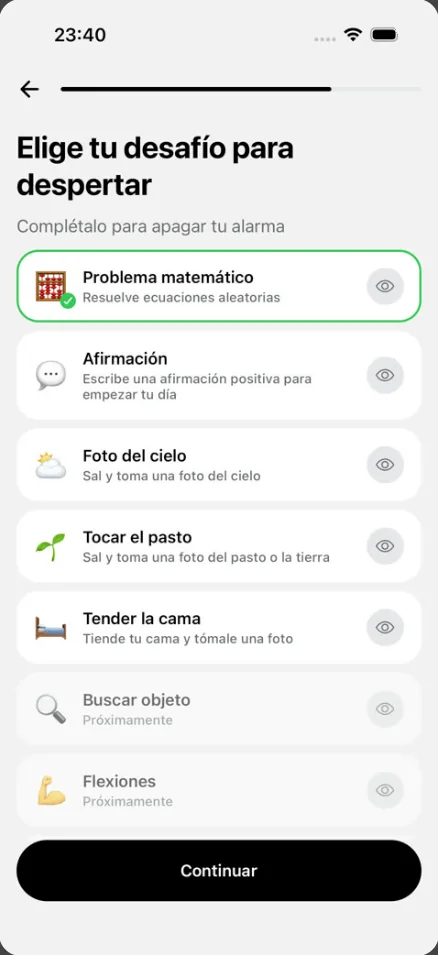
LevoUp has no snooze button, and you choose the mission when you create each alarm. Right now you can choose from math problem, affirmation, photo of the sky, touch grass and make your bed; push-ups, squats and find an object are coming soon. For waking up early, the photo missions work especially well: you have to get up, and the sky photo also gets you natural light first thing.
Want to compare options? Our guide to the best alarm app for iPhone covers the alternatives.
Step 6: have a reason to get up early
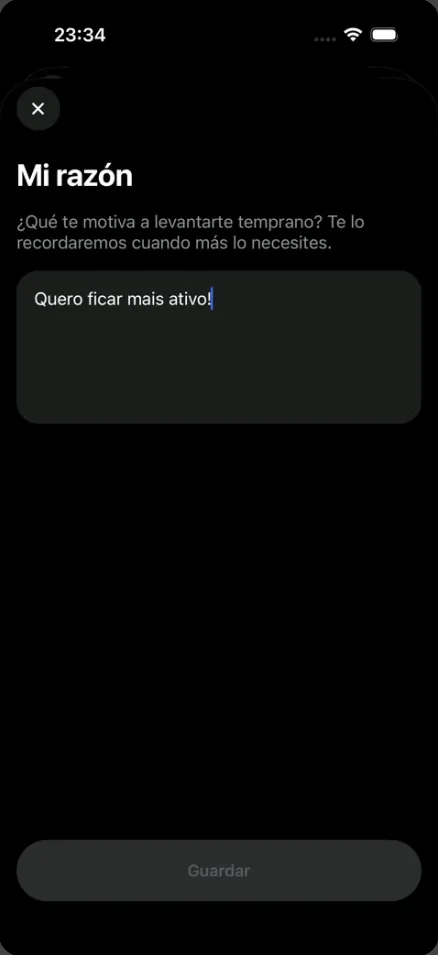
“Getting up early” isn't a goal; it's a means. What gets you out of bed is knowing why: hitting the gym before work, studying while the house is quiet, a calm breakfast or an hour just for yourself. Write it down and keep it where you'll see it.
Seeing your progress helps too: in LevoUp, every morning you get up on the first alarm adds to your streak, and the rest days you mark don't break it.
Mistakes that make you give up on waking up early
- Moving the alarm without moving your sleep. Getting up early on 5 hours of sleep isn't sustainable.
- Changing everything at once. Two hours earlier overnight almost always ends with quitting.
- Catching up on sleep at the weekend. Big schedule swings throw off your clock every Monday.
- Several backup alarms. They teach you to ignore the first one.
- Giving up after a bad day. If you miss a morning, pick it up again the next day without changing the plan.
If snooze is your main problem, we have a full guide on how to stop hitting snooze.
When to see a doctor
Some people have a naturally later chronotype and will always find early mornings a bit harder, and that's normal. But if you sleep 7–9 hours on a regular schedule and still wake up exhausted, feel very sleepy during the day, snore loudly or have a lot of trouble falling asleep at night, talk to a doctor. It could be a sleep disorder that no routine or alarm will fix.
Frequently asked questions
How long does it take to get used to waking up early?
It depends on how far you want to shift. Moving about 15 minutes earlier every two or three days, going from 7:30 to 6:00 takes around two weeks. Keeping the same schedule on weekends helps the change settle in faster.
How do I wake up early if I go to bed late?
Moving the alarm isn't enough: you also need to move your bedtime. Start by getting natural light as soon as you're up and cutting back on screens and bright light at night; that helps you feel sleepy earlier.
How many hours of sleep do I need to wake up early and feel good?
The American Academy of Sleep Medicine recommends that adults sleep 7 or more hours per night. Count backward from your wake-up time and add about 15 minutes to fall asleep.
Is it better to set several alarms so I don't oversleep?
Usually not. With several alarms your brain learns the first one doesn't count and you end up snoozing. One alarm with no snooze, away from your bed or with a mission that forces you to wake up fully, works better.
What should I do right after waking up so I don't fall back asleep?
Stand up right away, get natural light by opening the curtains or stepping outside, drink some water and move. A mission alarm, like taking a photo of the sky or making your bed, makes you do this before you can turn it off.